

How to Choose the Best Tumbling Mat for Home, Gymnastics, Cheer, or Fitness
The right tumbling mat depends on how it will be used, the amount of floor space available, the type of support or cushioning needed, and how often the mat will be moved or stored. Some mats provide a firm surface for sure-footed tumbling, while others offer a softer feel, added rebound, or markings for specific activities. Tumbl Trak offers several folding and modular mats for home training, gymnastics clubs, cheer programs, dance studios, schools, fitness spaces, and therapeutic settings. Use this guide to compare their construction, surface feel, dimensions, connection options, and best uses.
Tumbling Mats and Landing Mats Serve Different Purposes
A tumbling or panel mat creates a supportive practice surface for skills performed within an athlete’s ability level. It is not designed to replace a thick landing or crash mat for cushioning falls, dismounts, or uncontrolled landings. Choose matting for the activity being performed, the equipment being used, and the athlete’s needs, and provide appropriate supervision.
Which Tumbl Trak Tumbling Mat Is Right for You?
Best All-Purpose Mat: Gymnastic Tumbling Mat
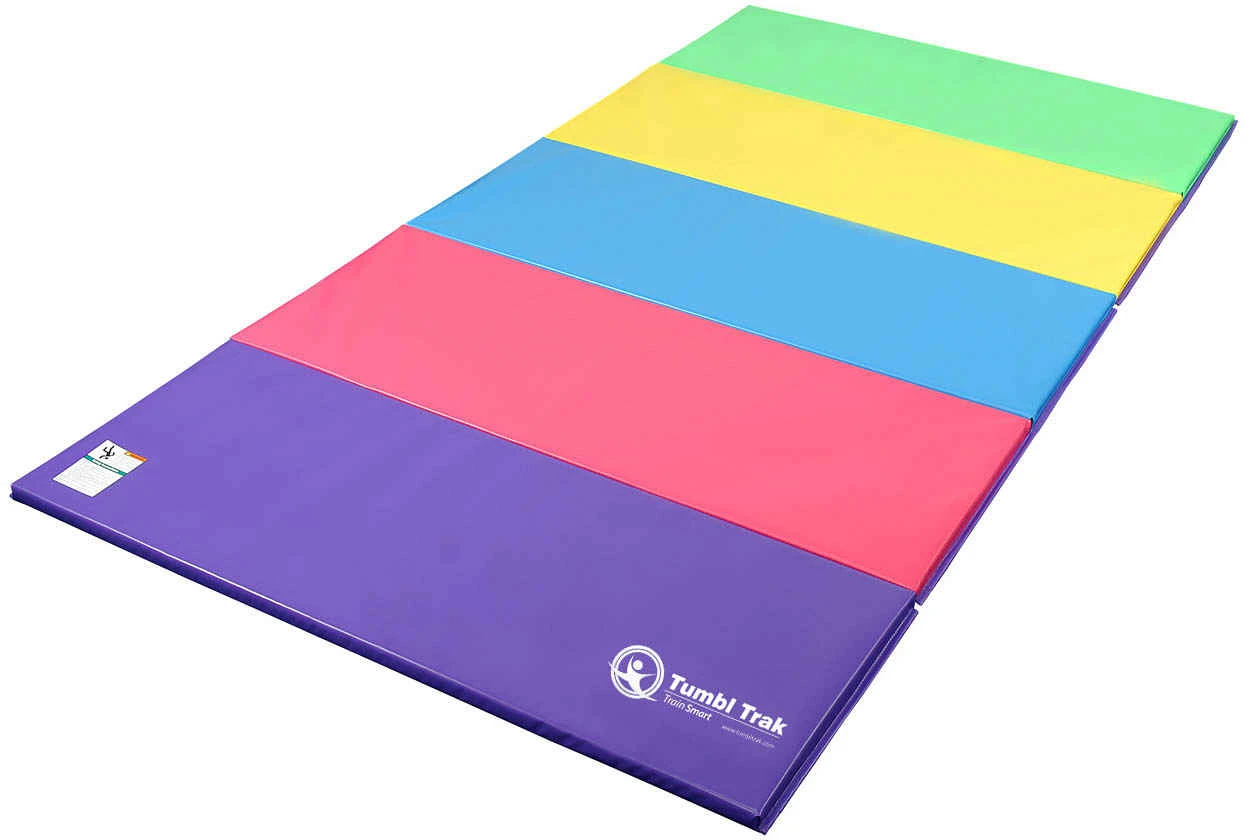
Choose the Gymnastic Tumbling Mat when you want a durable, firm, folding surface for everyday gymnastics, cheer, dance, martial arts, fitness, or home practice. It is available in several sizes and two thicknesses, folds in 2-ft panels, and connects end-to-end with additional mats.
Best for: General tumbling, floor exercises, stretching, conditioning, and use beneath compatible low training equipment
Shop the Gymnastic Tumbling Mat
Best Modular Option: Build-a-Mat
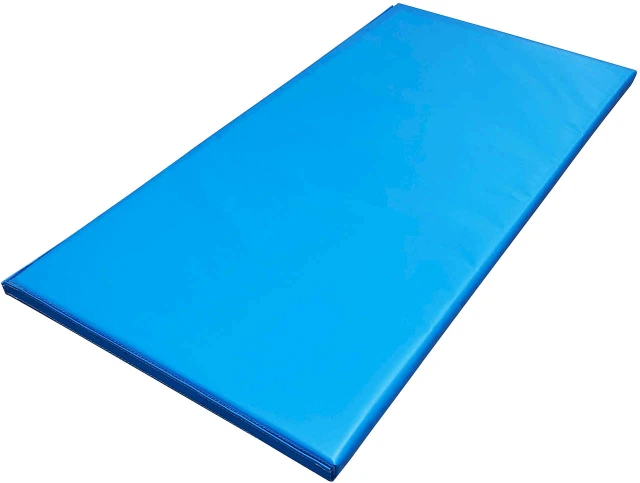
Choose the Build-a-Mat when you want smaller sections that can be arranged, connected, stacked, or expanded to fit a particular station or space. Hook-and-loop fasteners on all four sides make it the most customizable option in this guide.
Best for: Small spaces, individual stations, custom layouts, color-coded activities, and programs that want to expand over time
Shop the Build-a-Mat
Best for Added Rebound and Cheer Stunting: Rebound Mat

Choose the Rebound Mat when you want a thicker, more forgiving tumbling surface with added rebound. Its two-layer foam construction combines a supportive top layer with a softer bottom layer. Cheer programs especially appreciate the Rebound Mat for stunting: two 5-ft by 10-ft mats can be connected side by side to create a 10-ft by 10-ft stunt area.
Best for: Higher-level tumbling practice, cheer stunting, and athletes or programs that prefer more rebound and cushioning than a standard panel mat
Shop the Rebound Mat
Best for Beam Drills and Guided Activities: Hopscotch Beam Mat
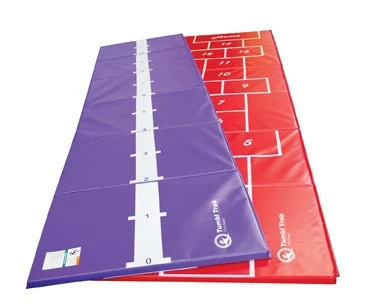
Choose the Hopscotch Beam Mat when you want the firm construction of a traditional tumbling mat in a narrower, longer format with printed activity lines. One side features a beam stripe with 1-ft increments, while the reverse side features a hopscotch pattern.
Best for: Beam stations, movement activities, preschool and recreational classes, tumbling lines, and adaptive or therapeutic programs
Shop the Hopscotch Beam Mat
Best Softer First Mat: Jack or Jill Mat

Choose the Jack or Jill Mat when you want a softer, more forgiving feel for introductory floor skills. Its two-layer foam construction and narrow 18-in folding panels also allow it to fold into a useful 8-in-high block.
Best for: Introductory skills, young athletes, home practice, and anyone who benefits from a softer-feeling practice surface
Shop the Jack or Jill Mat
Do You Need a Firm Mat or a More Forgiving Mat?
Surface feel is one of the most important differences among these mats. Firmer cross-linked foam provides a stable surface for hands and feet. Layered mats that include open-cell foam compress more and feel softer or more responsive under the athlete.
Choose a firmer surface for sure-footed practice.
The Gymnastic Tumbling Mat, Build-a-Mat, and Hopscotch Beam Mat use cross-linked foam to provide stable support for tumbling, stations, stretching, and general activity. The Hopscotch Mat performs much like a standard tumbling mat, but its 3-ft width, 12-ft length, and printed lines make it especially useful for guided drills.
Choose layered foam for a softer or more responsive feel.
The Jack or Jill Mat combines open-cell and closed-cell foam for a softer, more forgiving feel. The Rebound Mat uses a supportive cross-linked foam top layer over an open-cell foam bottom layer to provide both stability and added rebound. Neither should be treated as a substitute for matting specifically designed for landings or falls.
Tumbl Trak Tumbling Mat Comparison
| Product | Best For | Surface Feel | Dimensions | Foam Construction | Folding / Storage | Connection Options | Key Advantage |
|---|---|---|---|---|---|---|---|
| Gymnastic Tumbling Mat | Everyday tumbling and general-purpose training | Firm and supportive | 4 ft × 6 ft, 4 ft × 8 ft, or 5 ft × 10 ft; each in 1⅜ or 2 in | Cross-linked foam | Folds in 2-ft panels | Hook-and-loop fasteners on short ends for end-to-end connections | Most versatile range of sizes and thicknesses |
| Build-a-Mat | Custom layouts, compact stations, and expandable spaces | Firm and supportive | 2 ft × 4 ft × 1⅜ in or 2 ft × 5 ft × 1⅜ in | Cross-linked foam | Individual sections separate and stack | Hook-and-loop fasteners on all four sides | Greatest layout flexibility |
| Rebound Mat | Added rebound, higher-level practice, and cheer stunting | Thicker, more forgiving, and responsive | 5 ft × 10 ft × 2⅜ in | 1⅜-in cross-linked foam top plus 1-in open-cell foam bottom | Folds into five 2-ft panels | Available with fasteners on two or four sides; two four-sided mats can form a 10-ft × 10-ft area | Added rebound and a useful cheer stunt-area configuration |
| Hopscotch Beam Mat | Beam drills, guided movement, and long narrow stations | Firm and supportive | 3 ft × 12 ft × 1⅜ in | Cross-linked foam | Folds every 2 ft into an approximately 3-ft × 2-ft × 9-in block | Designed primarily as a self-contained activity mat | Reversible beam and hopscotch graphics |
| Jack or Jill Mat | Introductory skills and a softer first practice surface | Soft and forgiving | 4 ft × 6 ft × 2 in | 1-in open-cell foam top plus 1-in closed-cell foam bottom | Folds in 18-in panels into an approximately 18-in × 4-ft × 8-in block | Designed primarily as a self-contained mat | Softer feel and compact folded-block uses |
Why Choose Each Tumbl Trak Mat?
Gymnastic Tumbling Mat: The Everyday Workhorse
The Gymnastic Tumbling Mat is the best starting point for most shoppers. Its firm cross-linked foam gives athletes a stable surface for cartwheels, handstands, rolls, stretching, conditioning, and other controlled skills. Durable 18-oz knife-coated vinyl and 2-ft folding panels make it practical for frequent use, cleaning, transport, and storage. Choose among 4-ft by 6-ft, 4-ft by 8-ft, and 5-ft by 10-ft sizes, each in either 1⅜-in or 2-in thickness. Hook-and-loop fasteners on the two short ends allow multiple mats to connect into a longer lane. On smooth hard floors, compatible non-slip mat sheets can help reduce movement.
Shop the Gymnastic Tumbling Mat
Build-a-Mat: Create the Layout You Need
Build-a-Mat sections are smaller than conventional folding panel mats and connect on all four sides. Use one section for a focused station, connect several into a runway or floor area, combine colors to define activities, or separate and stack the pieces for storage. The 1⅜-in-thick sections are available in either 2-ft by 4-ft or 2-ft by 5-ft sizes, making them easier to use in compact or unusually shaped spaces. Build-a-Mat uses the same type of firm cross-linked foam and durable 18-oz knife-coated vinyl associated with Tumbl Trak’s standard panel mats. It is the strongest choice when configuration flexibility matters more than having one large folding mat.
Shop the Build-a-Mat
Rebound Mat: Added Response for Tumbling and Cheer
At 2⅜ in thick, the Rebound Mat is the thickest mat in this comparison. Its two-layer construction places 1⅜ in of supportive cross-linked foam over 1 in of softer open-cell foam. The result is a more forgiving and responsive feel than a standard tumbling mat while retaining a stable top surface. The 5-ft by 10-ft mat folds into five manageable panels and has a non-skid bottom. Select the four-sided connection option when you want the greatest layout flexibility. Cheer programs can connect two mats side by side to create a 10-ft by 10-ft stunt area, or connect mats end-to-end for a longer tumbling surface.
Shop the Rebound Mat
Hopscotch Beam Mat: A Tumbling Mat with Built-In Visual Activities
The Hopscotch Beam Mat is much like a regular firm 1 ⅜-in thick tumbling mat, but its narrower 3-ft width, 12-ft length, and reversible printed graphics give it a more specialized role. The beam side includes a straight stripe marked in 1-ft increments for balance, distance, and movement drills. Turn the mat over to reveal a hopscotch pattern for jumping, sequencing, and motor-planning activities. Its long, narrow shape also works well under an 8-ft low balance beam or as a defined tumbling lane. Because the Hopscotch Beam Mat overlaps both general tumbling and activity-based uses, it can remain in this guide while also appearing in Tumbl Trak’s specialty-mat buying guide.
Shop the Hopscotch Beam Mat
Jack or Jill Mat: A Softer Introduction to Floor Skills
The Jack or Jill Mat combines a softer open-cell foam top layer with a closed-cell foam bottom layer. This creates a more forgiving practice surface than a standard firm panel mat, making it a welcoming first mat for introductory rolls, cartwheels, stretching, and supervised floor activities. Narrow 18-in panels allow the 4-ft by 6-ft mat to fold into an approximately 8-in-high block for sitting, shaping, or selected drills. A non-skid bottom helps the mat remain in place on appropriate surfaces.
Shop the Jack or Jill Mat
What Should You Consider When Choosing a Tumbling Mat?
1. Intended Use
Start with the activity rather than choosing by size alone. A firm Gymnastic Tumbling Mat works well for general floor practice. Build-a-Mat is ideal for changing layouts. The Rebound Mat adds response for tumbling and creates an especially useful cheer-stunting area. Hopscotch adds visual guidance, while the Jack or Jill Mat provides a softer feel for introductory work.
2. Foam Construction and Surface Feel
Cross-linked foam is firm, resilient, and supportive. Open-cell foam compresses more and contributes a softer or more responsive feel. A thicker mat is not automatically the right mat for every activity; construction and intended use matter just as much as the listed thickness.
3. Size and Training Space
Measure the available area before ordering and leave adequate clear space for the skills being performed. A 4-ft by 6-ft mat may be enough for individual skills, while a longer surface supports connected movements. Modular or connectable mats can be useful when the space or training needs may change.
4. Floor Surface
Mats may behave differently on carpet, wood, tile, or other smooth flooring. Tumbl Trak generally suggests a 2-in standard Tumbling Mat on hardwood and a 1⅜-in version on carpet. Non-skid bottoms or compatible non-slip mat sheets can help reduce movement, but the complete setup should always be evaluated before use.
5. Connections and Expansion
Standard Tumbling Mats connect at the short ends to create longer lanes. Build-a-Mat sections connect on all four sides for customized shapes. Rebound Mats are available with two-sided or four-sided connections; the four-sided option is necessary for side-by-side layouts such as a 10-ft by 10-ft cheer stunt area.
6. Storage and Portability
Consider both the open dimensions and the folded size. Standard Tumbling Mats and Rebound Mats fold in 2-ft panels. The Hopscotch Mat folds into a compact block despite its 12-ft length, and the Jack or Jill Mat uses narrower 18-in panels. Build-a-Mat sections separate and stack instead of folding as one mat.
7. Practice Matting vs. Landing Protection
Do not choose a tumbling mat solely because it appears thick enough for a landing. Controlled floor practice, equipment matting, and landing protection have different requirements. Use a dedicated landing mat where the activity calls for cushioning falls, dismounts, or uncontrolled landings.
Frequently Asked Questions About Tumbling Mats
Which Tumbl Trak mat is best for general home gymnastics practice?
The Gymnastic Tumbling Mat is the best all-purpose choice for most home training spaces. It provides firm support, folds for storage, comes in several sizes and thicknesses, and can connect end-to-end with another mat.
What is the difference between a tumbling mat and a landing mat?
A tumbling mat provides a supportive surface for controlled floor skills. A landing mat is designed with greater depth and cushioning for landings or falls. A standard panel mat should not be used as a substitute for a landing or crash mat.
Should I choose a 1⅜-in or 2-in Gymnastic Tumbling Mat?
For home use, Tumbl Trak generally suggests the 2-in mat on a hard surface such as hardwood and the 1⅜-in mat on carpet. The right choice also depends on the activity, athlete, and complete training setup.
Which mat is best for cheer stunting?
The Rebound Mat is the strongest choice in this comparison for cheer stunting because it offers a thicker, more responsive surface and flexible connection options. Two four-sided 5-ft by 10-ft Rebound Mats can connect side by side to create a 10-ft by 10-ft stunt area.
What is the difference between the Gymnastic Tumbling Mat and Rebound Mat?
The Gymnastic Tumbling Mat uses firm cross-linked foam and is available in several sizes and two thicknesses. The Rebound Mat is a single 5-ft by 10-ft, 2⅜-in-thick size with a cross-linked foam top layer and softer open-cell foam bottom layer, giving it added rebound and a more forgiving feel.
What is the difference between Build-a-Mat and a folding tumbling mat?
Build-a-Mat consists of small individual sections that connect on all four sides and can be rearranged or stacked. A conventional Tumbling Mat is one larger unit that folds in panels and connects to other mats at the short ends.
Is the Hopscotch Beam Mat a regular tumbling mat or a specialty mat?
It is both. Its firm foam and folding construction are similar to a regular tumbling mat, while its narrow shape and reversible beam and hopscotch graphics make it useful for specialized drills and guided activities. That is why it appears in both Tumbl Trak’s tumbling-mat and specialty-mat guidance.
Which Tumbl Trak mat has the softest feel?
The Jack or Jill Mat is designed as a soft, forgiving first mat. The Rebound Mat is also more forgiving than a standard Tumbling Mat, but its construction is designed to combine cushioning with added rebound for tumbling and stunting.
Can Tumbl Trak tumbling mats be connected?
Yes, although the connection options vary. Standard Tumbling Mats connect end-to-end, Build-a-Mat connects on all four sides, and Rebound Mats can be ordered with two-sided or four-sided fasteners. Check the product configuration before ordering if a particular layout is important.
How should I clean a vinyl tumbling mat?
Clean vinyl surfaces with mild soap and water, then allow them to dry fully. Do not use bleach or bleach-based products. Follow the care instructions for the specific mat.
Can I place a tumbling mat under a balance beam or training bar?
Some tumbling mats may be used as part of a matting configuration beneath compatible low training equipment, but the proper type, thickness, coverage, and arrangement depend on the equipment and skills. Follow the equipment’s specific matting recommendations rather than assuming one mat fits every setup.
Still Not Sure Which Tumbling Mat to Choose?
For the most versatile everyday option: Choose the Gymnastic Tumbling Mat.
For a customizable or expandable layout: Choose Build-a-Mat.
For added rebound or a cheer-stunting setup: Choose the Rebound Mat.
For a long, narrow mat with beam and movement markings: Choose the Hopscotch Beam Mat.
For a softer first practice mat: Choose the Jack or Jill Mat.
Need Help Choosing the Right Equipment?
Our team is happy to help you evaluate athlete age, skill level, available space and budget to find the perfect setup.
Contact Tumbl Trak Support